

Oneworld member Alaska Airlines has announced significant changes to its frequent flyer program, Atmos Rewards (formerly Mileage Plan), effective January 2027. Starting then, members will have three different ways to earn status and redeemable miles. However, users must choose one of these paths. Changes to your selection are only permitted once per year, and thereafter only at the start of the next calendar year.
For travelers based in Europe, the new options are largely positive. After the program significantly cut mileage accrual for partner airlines two years ago, things are looking up for 2027. When flying with partner airlines, members will essentially choose between 100% mileage credit in Economy Class (excluding Basic Economy) or a massive 250% credit on international Business Class flights.
However, it’s not all good news. Those who regularly fly a mix of many short-haul and long-haul flights across different cabins within the Oneworld alliance may find themselves worse off than before. Furthermore, while the 100% Economy Class credit sounds appealing, it comes with several notable exceptions.
Three Different Ways to Earn Miles
Many loyalty programs offer multiple paths to status: either through spending, segments, or distance flown. Atmos Rewards, however, differs in two key ways. First, users must actively select their preferred earning method. Second, this choice affects both redeemable and status miles simultaneously.
Members can now log in to AlaskaAir.com to make their selection, which looks like this:
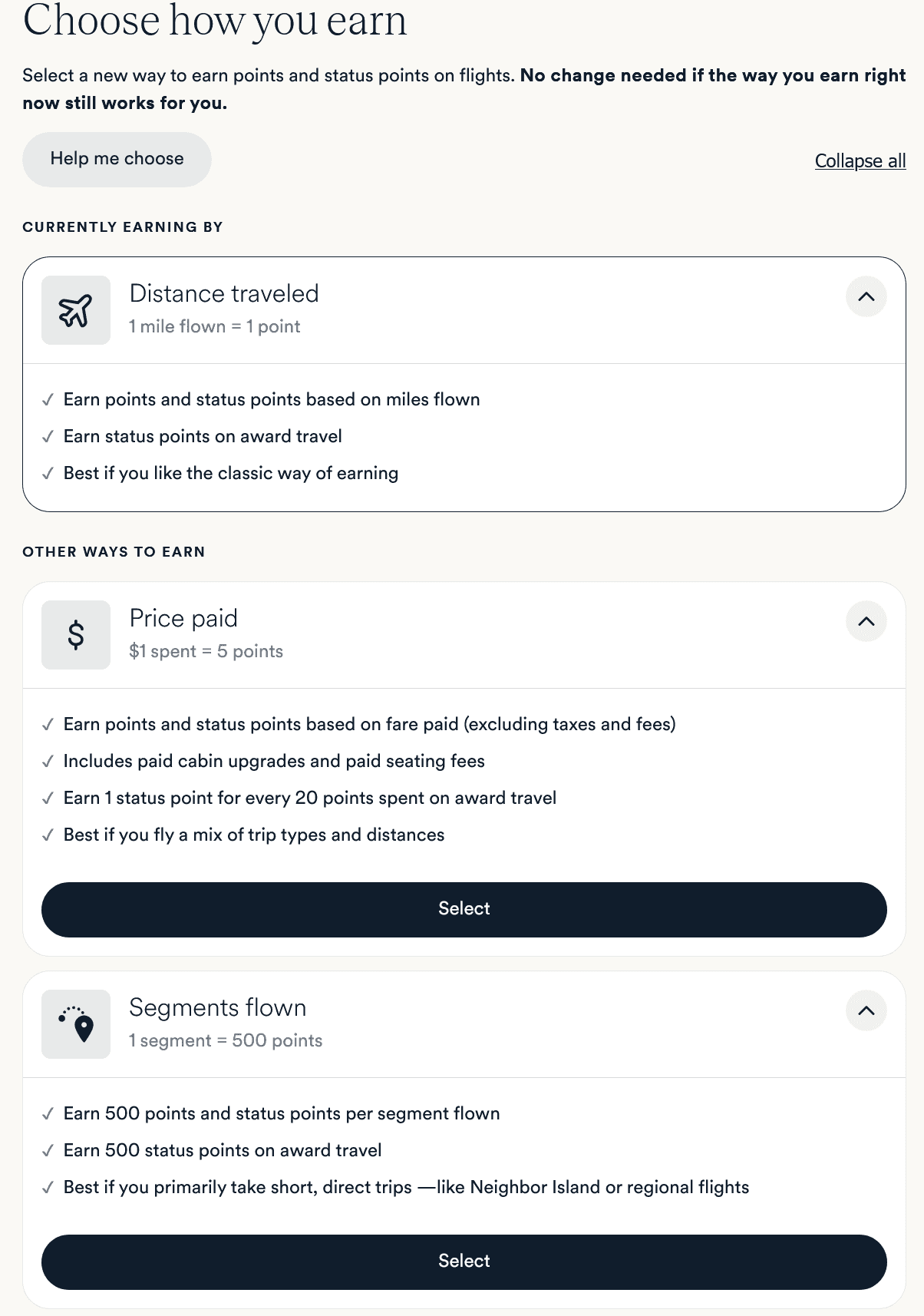
By default, the Distance traveled option is pre-selected. The website claims: “No change needed if the way you earn right now still works for you.” This is somewhat misleading, as there are significant changes even within that specific path.
Here is an overview of the key details and pitfalls for each option:
- Earning by Distance:
- 100% status and redeemable miles for every mile flown on Alaska, Oneworld, and other partner airlines.
- All cabin bonuses for premium classes are eliminated.
- Zero miles for Basic Economy (including partner airlines) according to the terms.
- No miles earned on award flights.
- Earning by Spending (Revenue-based):
- Revenue-based status and redeemable miles (5 miles per USD) initially only for Alaska and American Airlines (on 001/027 ticket stock).
- For all other flights, status and redeemable miles are credited based on booking class and distance.
- Partner airline accrual: 25% to 250% of distance, depending on booking class.
- Award flight credit: 1 status point for every 20 redeemable miles used.
- Earning by Segments:
- Flat 500 redeemable and status miles per segment (with all airlines).
- 500 redeemable miles for all award flight segments.
- Likely zero miles for Basic Economy (including partner airlines).
Below is the new accrual table for partner flights, valid only if you choose the middle revenue/class-based option:

The existing status tiers remain unchanged:
- Atmos Silver: from 20,000 status miles/year (= Oneworld Ruby)
- Atmos Gold: from 40,000 status miles/year (= Oneworld Sapphire)
- Atmos Platinum: from 80,000 status miles/year (= Oneworld Emerald)
- Atmos Titanium: from 135,000 status miles/year (= Oneworld Emerald)
Which Variant Should I Choose?
In practice, only two options are worth serious consideration. The segment-based variant offers neither significant redeemable miles nor an efficient path to status compared to other Oneworld programs. This leaves the choice between distance-based and spending/class-based earning.
Earning 100% of distance miles in Economy Class sounds tempting. However, the exclusion of Basic Economy tickets (hidden in the fine print) makes it less attractive. For example, you would need to fly between Europe and the US West Coast four times (round-trip) to qualify for Oneworld Sapphire. You would also have to consistently choose a fare that includes a bag (typically a €130 surcharge) to earn any miles at all. On the plus side, you would accumulate a healthy balance of redeemable miles.
The spending-based option is not strictly revenue-based for most European travelers who rarely fly Alaska or American Airlines. For all other carriers, miles are awarded based on distance and booking class. While this is unattractive for Economy Classic (often earning just 25%), it is a huge win for Business Class. The current meager 125% credit will double to 250% of the distance. This means a single Business Class trip to the US West Coast would get you 75% of the way to Oneworld Sapphire status, while netting nearly 30,000 redeemable miles.
Extra Miles Through Communities and Elite Bonuses
In addition to the changes above, Atmos Rewards is introducing Communities with their own sets of perks. For members living outside Alaska or Hawaii, there are four choices:
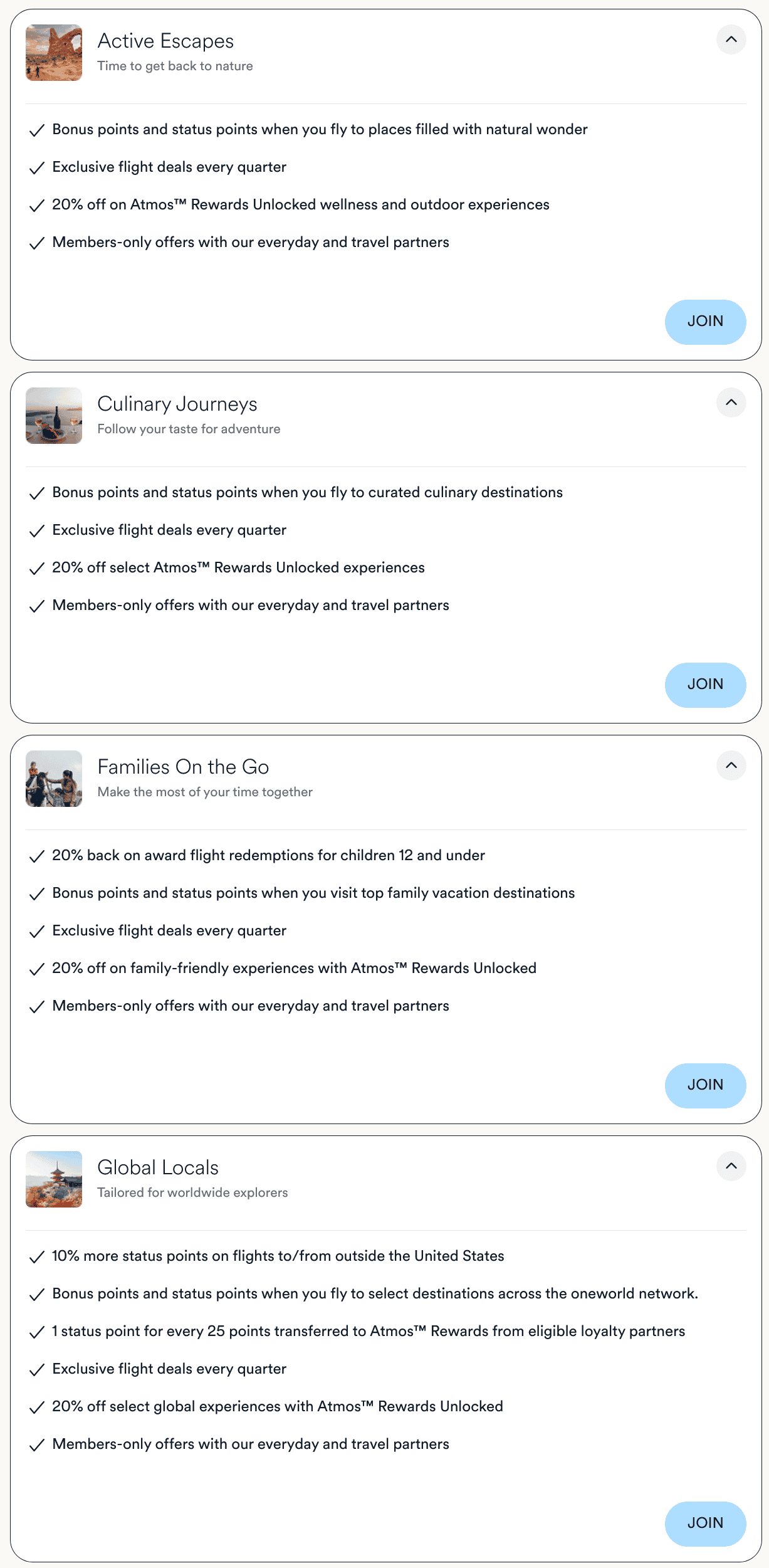
The Global Locals community is particularly noteworthy, primarily due to the 10% bonus on status miles for all non-US domestic flights. This makes Business Class travel even more rewarding. It remains to be seen whether the 10% applies to Base Points (100% in Business) or Total Points (250%).
Current elite bonuses will remain in place regardless of your chosen community: 25% for Silver, 50% for Gold, 100% for Platinum, and 150% for Titanium. These apply only to redeemable miles but will make the program even more lucrative moving forward.
Verdict
The new Atmos Rewards program is complex. However, barring any unpleasant surprises, it is poised to become one of the most attractive frequent flyer programs within the Oneworld alliance again. Business Class travelers, in particular, can look forward to high mileage accrual and an easier path to status—provided they select the correct earning preference in advance.
Source: One Mile at a Time